In construction, “soundproofing” is often used as a catch-all term, but for a contractor, it refers to a specific set of physics-based goals: blocking external noise and containing internal sound. Whether you are looking to silence a noisy neighbor or create a professional-grade home recording space, the approach must be systematic to be successful.
Quick Answer: True Soundproofing Requires Mass and Sealing
To truly stop sound, you must address two primary forces: mass and air. High-frequency sounds (voices, chirping) travel through air gaps, while low-frequency sounds (bass, footsteps) travel as vibrations through the solid structure of the building.
Why gaps and vibration matter
Sound behaves much like water; if there is a hole, it will leak through. A wall can be built with the thickest materials, but if there is a 1% gap around the baseboard or an electrical outlet, you can lose up to 50% of the wall’s sound-blocking effectiveness.
Furthermore, “flanking noise” occurs when sound vibrates through the wooden studs. Without “decoupling” (breaking the physical connection between the two sides of a wall), vibrations will travel directly through the studs, bypassing even the densest insulation.
Basic Soundproofing Methods
For those looking for immediate, non-invasive improvements, basic methods focus on absorption and air-sealing.
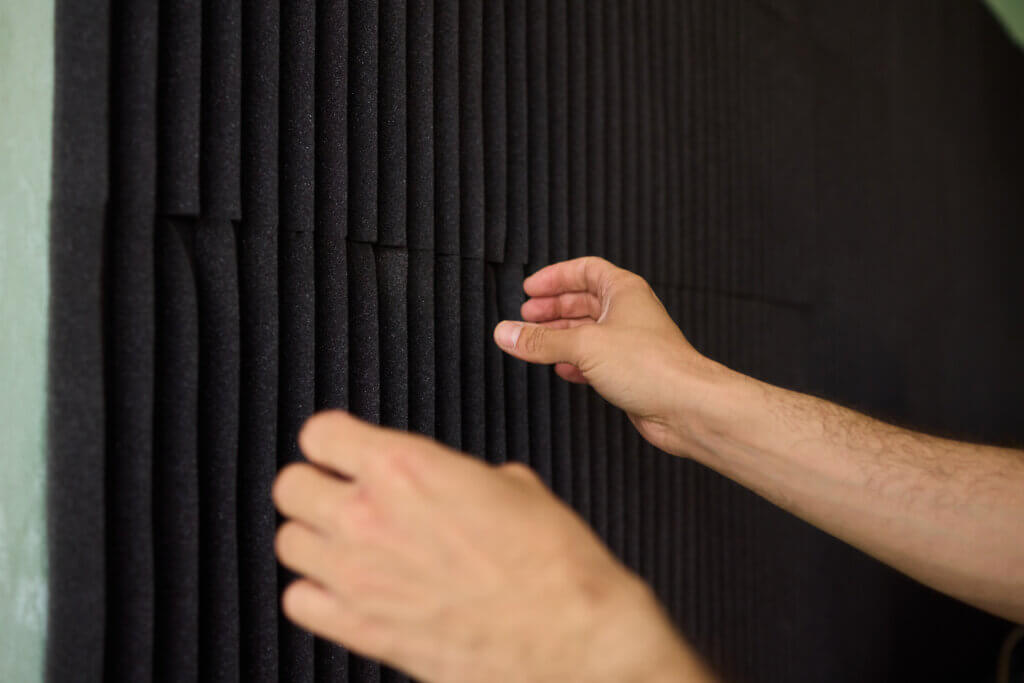
Acoustic panels and curtains
While these do not “block” sound from entering a room, they are essential for reducing the energy of the sound once it is inside.
- Acoustic Panels: These reduce the “bounce” of sound off hard drywall, making the room quieter and improving speech clarity.
- Soundproof Curtains: Heavy, multi-layered acoustic drapes can be installed over windows and doors to dampen street noise. They work by adding a layer of dense fabric that traps sound waves before they vibrate the glass.
Weatherstripping and sealants
This is the most cost-effective way to improve a wall’s performance.
- Acoustic Caulk: Unlike standard caulk, acoustic sealant remains flexible for decades. It is used to seal the gaps between the drywall and the floor, ceiling, and around electrical boxes to prevent “air-borne” sound leaks.
- Weatherstripping: Applying high-density foam or rubber strips to door frames ensures an airtight seal when the door is closed, significantly reducing noise transfer from hallways.
Advanced Wall Soundproofing Solutions
When basic methods fall short, we move into structural modifications that increase the STC (Sound Transmission Class) rating of the assembly.
Double drywall with soundproofing compound
One of the most effective retrofits is adding a second layer of 5/8″ drywall over the existing wall.
- Damping Compounds: By applying a specialized viscoelastic glue (such as Green Glue) between the two layers of drywall, we create a system that converts sound energy into heat.
- Results: This “constrained layer damping” is exceptionally effective at stopping the vibration of the wall surface itself.
Insulation inside wall cavities
If the wall is being built or the drywall is being removed, the empty “drum” effect of a hollow wall must be addressed.
- Mineral Wool: Standard fiberglass insulation is not dense enough for serious soundproofing. We use mineral wool (like Roxul/Rockwool), which has a much higher density and is specifically engineered for acoustic dampening and fire resistance.
- Blow-in Cellulose: For existing walls where you don’t want to remove drywall, high-density cellulose can be blown into the cavities through small holes to add mass and reduce resonance.
Soundproofing for Bedrooms vs Home Offices
The strategy for soundproofing depends heavily on the “mission” of the room.
Different noise priorities
- Bedrooms: The priority is usually blocking “intermittent” and “low-frequency” noise—barking dogs, car doors, or bathroom pipes. The focus is on the exterior-facing walls and sealing the bedroom door.
- Home Offices: The priority is “speech privacy” and “background noise reduction.” If you are on video calls all day, the goal is to stop sound from leaving the room and to eliminate echoes that make you sound like you are in a hollow box.
Budget considerations
A bedroom might only require a “Mass Loaded Vinyl” (MLV) curtain and acoustic sealant for a few hundred dollars. A professional home office or studio might require a “room-within-a-room” construction, including resilient channels to decouple the drywall from the studs, which is a significantly higher investment.
FAQs
Can you soundproof an existing wall?
Yes. You do not always have to “tear it down to the studs.” Adding a layer of Mass Loaded Vinyl followed by a second layer of drywall with a damping compound can provide professional results without a full demolition.
Is soundproof drywall worth it?
Products like QuietRock are highly effective because they contain internal layers of metal and polymers designed to stop sound. While more expensive per sheet than standard drywall, they save labor costs because you often only need one layer to achieve the same results as multiple layers of standard material.
How much noise reduction is realistic?
Total silence is rarely achievable in a standard residential build, but a 70% to 90% reduction in perceived noise is very realistic with advanced methods. This is the difference between hearing a neighbor’s conversation and hearing nothing at all.
At Greater Boston Contractors, we understand that every home has unique acoustic challenges. Our team of experts combines structural engineering with high-end finishing to ensure your space is as quiet as it is beautiful. Whether it’s a simple acoustic treatment or a complex sound-blocking renovation, we provide the expertise to get it done right the first time. Contact us today to discuss your soundproofing project.