Lighting is the “make-or-break” element of any bathroom. Poor lighting turns a relaxing sanctuary into a sterile, shadowed environment that makes grooming and relaxing difficult. At Greater Boston Contractors, we treat lighting as a crucial design layer, ensuring that your bathroom is both functional for your morning routine and atmospheric enough for a late-night soak.
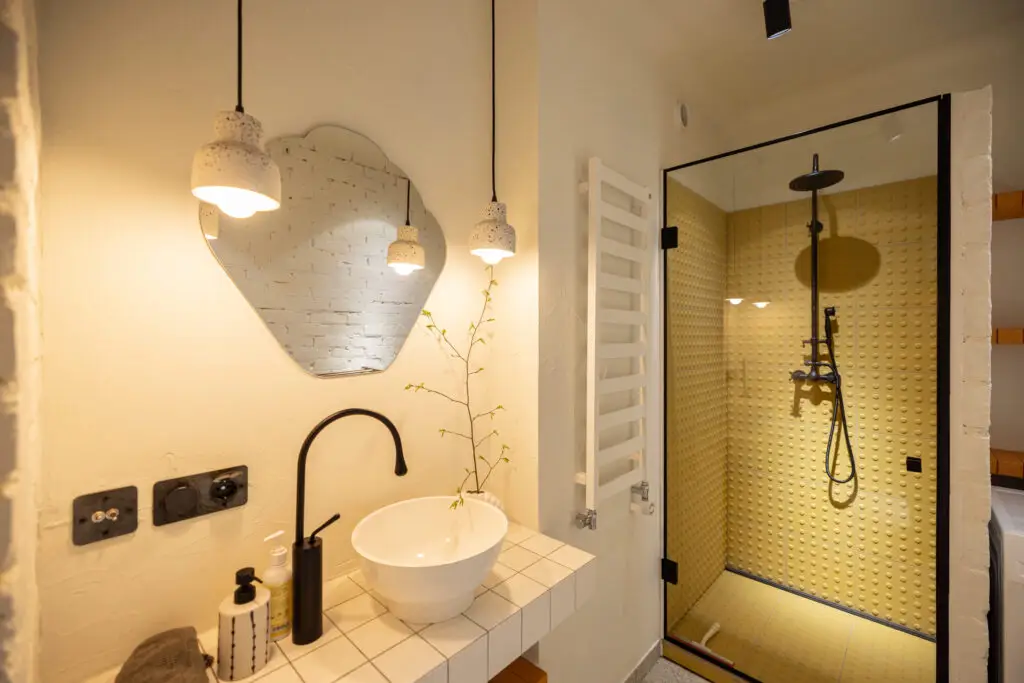
Quick Answer: What Lighting Is Best for Bathrooms?
The best bathroom lighting utilizes layering. You need a mix of ambient (general) light, task (vanity) light to eliminate shadows on your face, and accent light to create depth. For a versatile modern bathroom, aim for a color temperature of 3000K to 3500K (warm white) to balance brightness with comfort.
Why Bathroom Lighting Needs Layers
A single overhead light is rarely enough. It creates harsh shadows under your eyes and nose, which is the opposite of what you need at the vanity. By layering, you ensure the light hits where it’s needed—on your face for grooming, above the shower for safety, and throughout the room for general ambiance.
The Four Essential Lighting Layers
- Ambient Lighting: Your room’s “base” brightness. Recessed LED pot lights or a central ceiling fixture provide the general glow that fills the room.
- Task Lighting: Focused light for grooming. This is most important at the mirror. Wall-mounted sconces on either side of the vanity are the gold standard for shadow-free light.
- Accent Lighting: The “drama” layer. Think LED strips under a floating vanity or inside recessed wall niches to create a high-end, architectural feel.
- Shower Lighting: A necessity. You must use wet-rated recessed lighting to ensure the space is bright, safe, and free from dark corners.
Choosing the Right Lighting for Every Zone
- Vanity: Avoid lights directly above the mirror, which cast unflattering shadows. Place fixtures at eye level on either side of the mirror to illuminate your face evenly.
- Small Bathrooms: In tight spaces, a “less is more” approach is key. Use sleek, low-profile flush mounts or recessed lights to keep the ceiling line clean and prevent the room from feeling low or crowded.
- Showers & Tubs: Always prioritize IP65-rated (wet-rated) fixtures. For tubs, consider a dimmable fixture to transition the space from “morning prep” to “evening spa” mode.
Warm vs. Cool Light: Finding the Balance
- 2700K (Warm): Too yellow; can make the room feel dingy and isn’t ideal for seeing true skin tones.
- 3000K–3500K (Bright/Warm White): The “sweet spot” for bathrooms. It’s clean, bright, and vibrant enough for applying makeup while still feeling cozy.
- 4000K+ (Cool/Daylight): Often feels too clinical, similar to a hospital or office. Unless you prefer a very high-contrast “daylight” look, stick to the 3000K–3500K range.
Common Bathroom Lighting Mistakes
- Relying on one light source: One light in the center of the ceiling will leave your face in the dark when you stand at the vanity.
- Choosing the wrong bulb color: Mixing “warm” bulbs with “cool” bulbs creates an uneven, distracting aesthetic.
- Forgetting Dimmers: Every bathroom light should be on a dimmer. Being able to lower the lights for a midnight trip to the bathroom or a long bath is a luxury that costs very little to implement.
How Remodeling Improves Lighting
If your current lighting is failing, a remodel is the perfect time to fix the “behind the walls” infrastructure. We can add dedicated circuits for your vanity lighting, install waterproof housings in your shower, and integrate smart switches that allow you to control your layers of light with a single tap.
FAQ
What kind of lighting is best for bathrooms?
A combination of side-mounted vanity sconces for grooming and recessed ceiling lights for overall ambient illumination.
Should bathroom lights face up or down?
For vanity lighting, the light should ideally be diffused or directed toward your face. Sconces at eye level are superior to lights facing purely “up” or “down.”
What color temperature is best for bathrooms?
3000K to 3500K. It mimics natural morning light without the harshness of a blue-tinted daylight bulb.
How bright should bathroom vanity lights be?
Aim for a combined output of 600–800 lumens around your mirror for effective, shadow-free grooming.
Can you put recessed lighting in a shower?
Yes, but you must use fixtures specifically rated for “wet locations” (often designated as shower-trim or IP65-rated) to prevent moisture from causing electrical issues or corrosion.
Brighten up your home today! Lighting is the final, most impactful touch in any bathroom renovation. Contact Greater Boston Contractors today for a lighting consultation and let us help you transform your bathroom into the perfect space!