When homeowners or facility managers think of “waterproof” flooring, they often jump to tile or vinyl. However, for areas that face constant moisture, heavy impact, and safety concerns, there is a professional-grade solution that outclasses almost everything else: Epoxy Quartz.
At Greater Boston Contractors, we often recommend quartz systems for environments where failure is not an option. In this guide, we’ll explore why this rugged, multi-layered system might be the ultimate choice for your next project.
Quick Answer: What Is Epoxy Quartz Flooring?
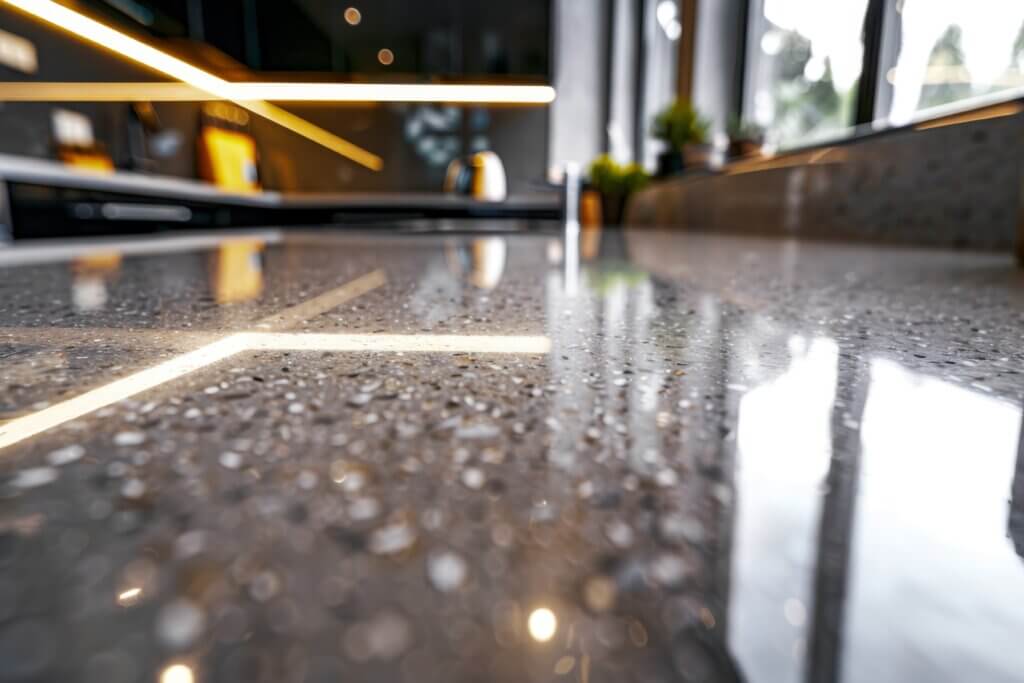
Epoxy quartz is not a single material, but a high-performance “broadcast” system designed for maximum durability.
Resin + Broadcast Quartz Aggregate + Topcoat System
The installation involves applying a high-grade epoxy base resin, followed by “broadcasting” (showering) colored quartz sand into the wet resin until it is saturated. Once cured, the excess sand is swept away, and a clear, chemical-resistant topcoat is applied. This creates a thick, seamless floor that is essentially a slab of synthetic stone bonded to your subfloor.
Why Quartz Systems Are Known for Traction and Hygiene Zones
Unlike smooth epoxy, the quartz aggregate creates a natural, sandpaper-like texture. This provides “mechanical traction,” making it inherently slip-resistant even when soaking wet. Furthermore, because it is a seamless, non-porous surface, there are no grout lines or cracks where bacteria, mold, or mildew can hide.
Where Quartz Floors Make the Most Sense
Mudrooms, Entries, Basements, and Laundry Rooms
In residential settings, quartz flooring is a game-changer for “transition zones.”
- Mudrooms & Entries: It handles the salt, snow, and grit brought in during harsh winters without scratching.
- Basements & Laundry Rooms: If a washing machine leaks or a basement experiences high humidity, quartz flooring remains unaffected. It acts as a secondary moisture barrier for the concrete slab.
Commercial Kitchens, Restrooms, and High-Moisture Facilities
For commercial applications, quartz is often a legal or safety requirement. Its ability to withstand high-pressure washing and aggressive cleaning chemicals makes it the standard for restrooms and food prep areas. It is designed to meet strict health code standards while providing a safe walking surface for staff.
Quartz vs. Flake Epoxy: Which Should You Choose?
Many people confuse quartz epoxy with “flake” epoxy (the speckled look common in garages). Here is how they compare:
Slip Resistance Differences and Texture Choices
- Quartz: Uses fine, hard grains of sand. It offers superior slip resistance and a more uniform, “tight” texture.
- Flake: Uses vinyl chips. While it can be made slip-resistant with additives, it is generally smoother and more focused on aesthetics than pure traction.
Cleaning, Durability, and Aesthetic Tradeoffs
Quartz is significantly harder than vinyl flakes. While flake floors are easier to “dust mop” because they are smoother, quartz floors are better suited for “wet scrubbing.” Aesthetically, quartz offers a sophisticated, stone-like shimmer, whereas flake systems provide a more traditional “granite” look.
What to Ask Before Installing a Quartz System
Slip Rating Goals (Light Texture vs. Aggressive)
Not all quartz floors feel the same. You can choose a “double broadcast” for maximum thickness or adjust the topcoat thickness to make the floor “shagreen” (lightly textured) or “aggressive” (heavy grip). Think about whether you’ll be walking on the floor with bare feet or heavy work boots.
Cove Base Needs, Drains, and Moisture Mitigation
If you are waterproofing a wet area, ask about a “Cove Base.” This involves pulling the epoxy up the wall 4 to 6 inches, creating a “bathtub effect” so water can’t seep into the drywall. Additionally, a professional installer should always test the concrete’s Moisture Vapor Emission Rate (MVER) before starting to ensure the epoxy won’t delaminate.
FAQs
Is quartz epoxy too rough for a home?
Not necessarily. While it is more textured than tile, the topcoat can be applied more heavily to “round off” the peaks of the quartz, making it comfortable enough for socks or bare feet in a basement or laundry room.
Does it yellow in sunlight?
Standard epoxy can amber over time when exposed to UV light. However, at Greater Boston Contractors, we use UV-stable Polyaspartic or Urethane topcoats to ensure your floor stays the exact color you chose for years to come.
How long is the downtime during installation?
A typical quartz system is a multi-day process. Day 1 is prep and base coat; Day 2 is the second broadcast; Day 3 is the topcoat. However, with fast-cure resins, floors can often be returned to full service within 24 to 48 hours after the final coat.
Upgrade to a Floor That Never Quits
If you’re tired of failing grout, peeling paint, or slippery surfaces in your wet areas, it’s time to consider the power of Epoxy Quartz. Greater Boston Contractors brings industrial-strength technology to your residential or commercial space with precision and style.
Click here to request your free quote and discover how an Epoxy Quartz system can protect your property!